


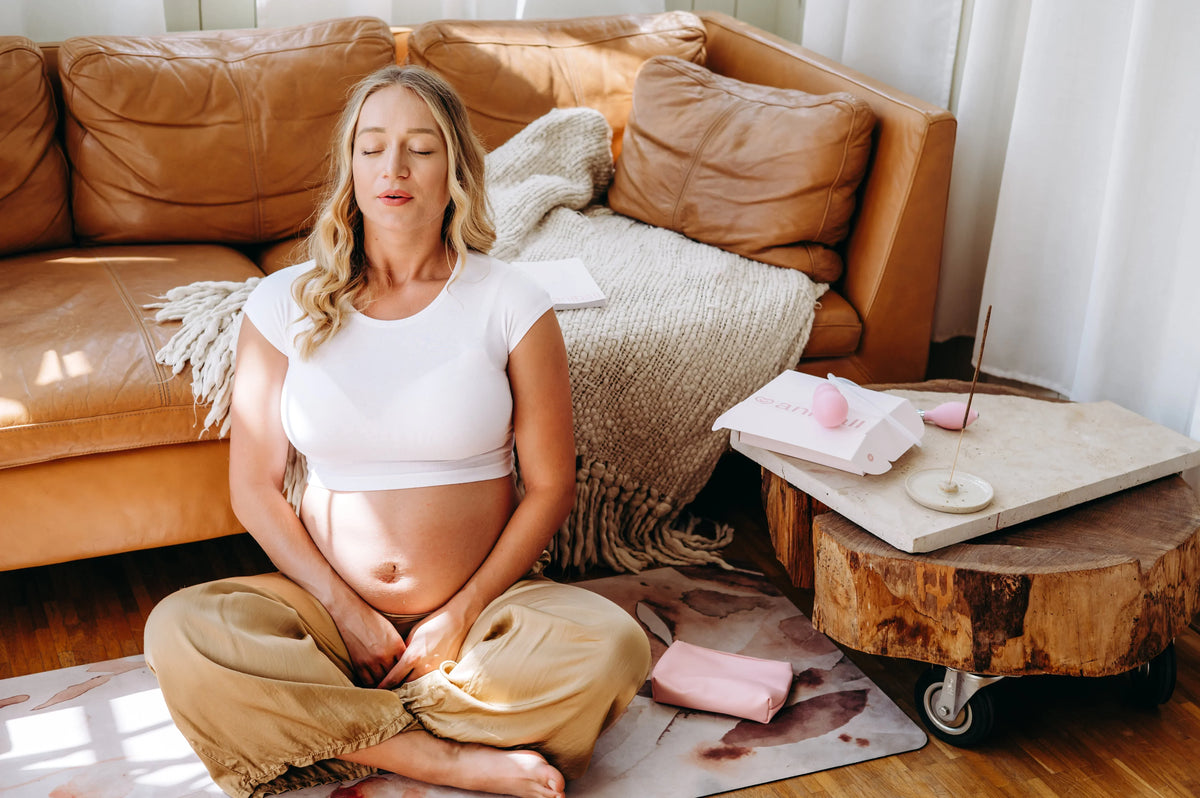
Why is breathing so important during Aniball exercises?
Aniball is a proprioceptive aid – that is, it teaches us to better perceive our own body. Its main benefit is that it helps us understand how to relax using the breath. If during the exercise we alternate a free, calm and deep breath into the abdomen with a slow, smooth exhalation, we adopt a basic principle that can significantly facilitate the baby's natural journey into the world.
What about breathing during childbirth?
The pelvic floor muscles work in the context of breathing. They relax when inhaling and contract when exhaling. We subconsciously believe that we should push while exhaling – but in that case, we are working against our own body, which is contracted at that moment. We push ‘by force,’ so to speak, and it is this forceful pushing that is often the cause of serious injuries during childbirth.
If we spontaneously relax the pelvic floor muscles by deep and uninterrupted breathing, we can give the baby the so-called breathe into the world - in accordance with the natural processes of our own body. Fierce "controlled" pushing, which forces us to hold our breath, pull in the navel and tighten the sphincters, increases the risk of birth injuries and endangers the baby with oxygen deficiency.
Can it be learned?
Breathing and targeted relaxation of the pelvic floor muscles can be trained with Aniball before childbirth. The balloon helps us realize that relaxation of the pelvic floor naturally comes with inhalation. It works simply - when inhaling, the balloon tends to move outward from the body, while when exhaling it moves inward.
What to do if the balloon fails to insert ?
Don't despair - this is one of the most common problems that women face at the beginning of Aniball exercises.
What helps the most?
- Slow down, take your time and don't rush,
- create a pleasant, relaxing atmosphere during exercise
- and most importantly, never forget to breathe during the balloon insertion.
Perceive your body as a whole and learn to gradually mobilize its individual parts with your breath parts. As you hold your breath, your whole body contracts - including your pelvic floor muscles - and the balloon is much harder to insert.
Why does this happen?
The pelvic floor and diaphragm work together, forming part of a whole chain of muscles (technically called the deep stabilization system). Think of them as a pump – they work in coordination, like Siamese twins. With inhalation, the diaphragm relaxes to accommodate the increased lung volume. The pelvic floor does the same, relaxing and sinking lower. With exhalation, the diaphragm contracts. And of course, the pelvic floor will also contract. You can read more about the impact of proper breathing on our everyday life here.
It is a spontaneous physiological process, it happens without our doing anything. But we can use it to our advantage - when inhaling, completely relax the whole body and without any problems insert the balloon. Proper breathing is not a science and there is no need to think about it in detail. Turn off your head, let your breath guide you.
How to start?
Try to take 10 calm, deep and smooth breaths into your abdomen and exhale, relaxation will come by itself. Watch how the balloon behaves during breathing – do you feel it moving slightly outwards with your inhale and a little back inwards with your exhale?
3 situations to watch out for
~ When inserting the balloon may sometimes have a tendency to slip out. Hold it with your hand, or try to inflate it slightly until you feel a slight tension. At the same time, it should never cause pain or other unpleasant sensations. Find your optimum and follow your intuition.
~ Don't measure it, it's not a race. Aniball is not a dilation aid, it is not possible to "stretch" the vagina and increase the circumference of the balloon. The prescribed 25 cm should be a limit that we never exceed. The maximum relaxation of the tissues occurs at birth, thanks to a special cocktail of hormones and contractions - until then, our body is not ready for a large circumference, and it is therefore risky to stretch the perineum unnecessarily and overcome the pain.
~ You do not have to try to expel the balloon right away, during the first days of exercise, caution and moderation are in order. After training, completely deflate and pull out the balloon with a clear conscience. Be kind to yourself and gradually, step by step, learn to breathe the balloon out into the world without pushing or pain.


